Amazon's emissions jump 16% amid AI boom
Published in Business News
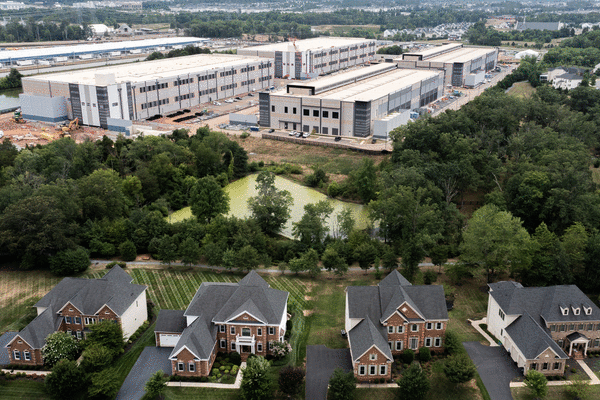
Amazon’s global carbon dioxide emissions spiked last year, as the tech giant scales up its ambitious artificial intelligence plans.
The Seattle-based company's emissions jumped 16% to almost 81 million metric tons of carbon dioxide in 2025, after three years of fluctuating emission levels, according to a sustainability report Amazon released Wednesday.
The rise was driven by an increase in indirect emissions from other sources, as Amazon’s AI-related splurge on data centers requires building materials like steel.
Fifteen years out from its 2040 goal to become carbon neutral, Amazon’s emissions have increased by roughly 58% since the company made its Climate Pledge in 2019. The company said it’s still committed to that goal as well as its 2030 self-imposed deadline to become water positive.
The company’s still-growing e-commerce business contributed as well. Amazon’s direct emissions — those that are caused by its operations — increased by 2% in 2025 from the previous year, as it delivered more packages than ever.
In the report, Amazon said it’s been trying to reduce the carbon footprint of its logistics network through electric vehicles and lower-carbon fuels. Emissions per shipped product are dropping, despite the overall increase.
Amazon reported emission increases in the past, though they were usually smaller upticks. But a metric that Amazon has previously used to show an overall downward trend rose in 2025 after years of decline. Carbon intensity, which measures carbon dioxide per dollar of revenue, increased 3% from 2024. For context, that metric has dropped by 38% since 2019.
Amazon acknowledged in its report that AI has been a major disruption for the tech industry and its sustainability efforts since the Climate Pledge was created in 2019.
“We’ve encountered tremendous change in each of the seven years since. Perhaps none bigger than AI,” Kara Hurst, Amazon’s chief sustainability officer, wrote in the report.
She went on to write that the technology is “both transforming what’s possible — accelerating discovery, optimizing systems and unlocking solutions that weren’t within reach before — yet also creating new demands for energy, water and infrastructure.”
That technology, as Hurst tells it, could enable Amazon to move faster on climate solutions. Or the demand could slow it down.
Amazon’s emissions from purchasing electricity rose 34% last year, driven by the boom in data centers and the electrification of its delivery network. Still, the company touted its data centers’ water usage, saying it is seven times more efficient than the industry average.
“I remain confident and optimistic in the overarching vision and the long-term progress we continue to make toward it,” Hurst wrote.
Amazon Employees for Climate Justice, an employee-led climate advocacy group, delivered a sharp rebuke to Amazon’s sustainability report and bemoaned the company’s vision of using AI to solve climate change challenges.
“Amazon’s leadership shows an extreme lack of responsibility for AI’s impact on the climate,” AECJ said in a news release Wednesday. “Despite Kara Hurst’s redirection to focus on how AI can create opportunities for sustainability, the company’s approach to AI is driving up emissions.”
The group has been critical of what it calls an irresponsible and “warp-speed” approach to rolling out AI.
While AECJ members are not calling for an overall ban on the technology or the data centers being built to support the demand, they have advocated for a slower and measured approach to building AI infrastructure.
Three Amazon employees, all members of AECJ, spoke in front of the Seattle City Council last month ahead of a vote to set a one-year moratorium on large-scale data centers in the city. Those employees said they were later pulled into “interrogation”-style meetings with human resources representatives at Amazon.
The group has also penned an open letter to Amazon leadership, signed by more than 1,200 Amazon employees and over 4,000 workers from other corporations and research universities, with demands for Amazon’s AI strategy. The letter calls for Amazon to power all data centers with renewable energy and provide a detailed plan for how the company plans to meet its climate commitments amid the AI boom.
“Amazon leadership’s response to a massive 16% increase in emissions is that they will ‘stay stubborn,’ but ‘flexible on the details,’” AECJ said in its news release. “Annual emissions going up 58% since the Climate Pledge was announced isn’t being ‘flexible on the details.’ ”
©2026 The Seattle Times. Visit seattletimes.com. Distributed by Tribune Content Agency, LLC.










Comments