Amid Haiti's latest gang war, a community hospital fights to stay alive
Published in News & Features
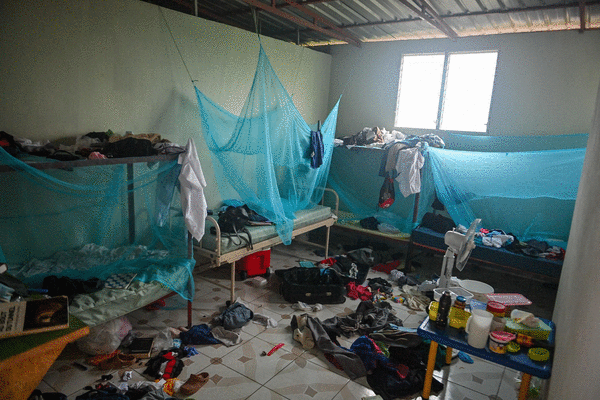
Roads lined with looted and charred buildings, gun smoke hanging in the air and the presence of heavily armed men and boys are stark reminders of the relentless violence consuming Haiti’s volatile capital.
For humanitarian workers and medical providers inside Cité Soleil, the sprawling seaside slum long synonymous with poverty and gang warfare, they are also reminders of the dangers that lurk at every corner.
So when rumors began spreading Sunday inside Centre Hospitalier de Fontaine, a family-run hospital inside the slum, that armed gangs were advancing toward the facility, there was only one thing left to do as panic swept through.
Caesarean sections were canceled. Newborns in incubators were transferred and doctors and nurses scrambled to find shelter amid fears the hospital would become the next casualty in Haiti’s escalating gang wars.
“It was the closest they had ever gotten,” Kareen Ulysse said about the armed gang members, who were about a mile away from the facility.
As the gunfire intensified, there was not just fear and uncertainty, she said, “because the last time they had gotten not too far from us.”
On Tuesday, as residents of Cité Soleil took to the streets waving tree branches and demanding government protection, La Fontaine Hospital announced that the armed clashes had forced it to temporarily suspend operations and evacuate all 32 of its hospitalized patients. The notice came a day after the French medical charity Doctors Without Borders/Médecins Sans Frontières announced the temporary suspension of its operations due to the escalation in violence.
It was the second time this year — and the fourth in recent years — that La Fontaine has been forced to take such drastic measures.
Among those either sent home or elsewhere: 11 newborns from the neonatal intensive care unit, 10 malnourished children under treatment; eight pregnant women, one pediatric patient, one emergency patient and one cholera patient.
Ulysse said she thought the hospital would have been able to reopen Tuesday because police had managed to push the gangs back the day before with armored tanks. But the intense fighting continued. On Wednesday, while speaking about the recent ordeal, she was fielding calls while also trying to see if the hospital could at least partially reopen for emergency services — not because the danger had subsided but because the demand for its services is so high.
“We had so many emergency surgeries waiting,” she said.
Haiti’s collapsing healthcare
Even before the gang crisis plunged more than half of Haiti’s 12 million people into raging hunger and drove nearly 1.5 million from their homes, the country faced a collapsing healthcare system. Hospitals lacked funding, not to mention basics like hypodermic needles and bandages.
The gang violence and the shuttering of the U.S. Agency for International Development, a significant funder of healthcare in Haiti, have put the health sector on life support. Hospitals that haven’t been looted, burned or shuttered are dealing with limited budgets and the tightening grip of armed gangs.
For healthcare workers on the front lines, many of whom have become victims of the terror themselves, the pressure is not just physical but psychological.
“Right now I have 55 of my staff members who came to my house and another apartment,” Ulysse said. “They are bursting into tears.”
The most recent gang threat, in which stray bullets were hitting homes, Ulysse said, “was scary. We’ve been through a lot,” she added. “But this was bad. Everybody was running.”
The armed violence in Cité Soleil and the neighboring Cul-de-Sac plain has been flaring up on and off since February. But the latest attacks intensified sharply over the weekend.
Armed violence also ramped up in the Lower Artibonite region, where Hôpital Albert Schweitzer in Deschapelles remains on high alert.
Initial reports from the United Nations’ International Organization for Migration indicate that more than 5,300 residents in the Cité Soleil commune have fled their homes. More than half are sheltering in a dozen temporary displacement sites, while others have sought refuge with already overstretched families, said Farhan Haq, deputy spokesman for U.N. Secretary-General António Guterres.
Haq said Wednesday that the crisis is also endangering lives in other ways. For example, the forced evacuation of Médecins Sans Frontières came after 800 displaced people had taken refuge on its grounds and after doctors had treated more than 40 gunshot victims and patients transferred from La Fontaine.
“The scale of the violence has had immediate consequences for people’s access to life‑saving healthcare,” Haq said.
Residents are sleeping in roadways, in public parks — anywhere but their own homes, fleeing the latest attacks that have left burned cars and more dead bodies. The number of people who died in the attacks remain unknown. Authorities say they are deploying security forces, but not are not commenting on the death toll.
In a social media post, Haiti police said they had deployed to the Cul-de-Sac plain. But among the police force’s targets was the vehicle of a journalist. His car, parked in front of his house, had 13 bullet holes.
Pointing to recent anti-gang action, police say armed groups now control about 70% of the capital, down from 90%. Still, reports of attacks are mounting, especially outside of Port-au-Prince, as are reports of kidnappings and sexual assaults.
Hospital is an oasis
Inside the sprawling slum, where gang violence has left scores of children orphaned, rapes of women and girls are frequent and cholera, hunger and malnutrition remain entrenched, La Fontaine is widely seen as both an oasis and a lifeline.
The hospital was founded in 1991 by Ulysse’s dad, Jose, a native of Cap-Haïtien. He was attending seminary in Port-au-Prince when he was assigned a project in Cité Soleil and recognized the desperate need for primary healthcare.
“He’s not a doctor. Neither am I,” said Kareen Ulysse. “He just saw a need and constructed the building.”
The first month after a 700-square foot facility opened, so many people came that Jose Ulysse “kept it going,” said his daughter. No longer studying to become a priest, he went into engineering and worked in the government’s public works ministry and for the National Equipment Center building roads and draining canals.
As he got better-paying jobs, Jose Ulysse invested as much as 40% of his income into the facility, gradually expanding it into one of the area’s few functioning health facilities. In 2018, Kareen Ulysse quit her teaching job in southern Georgia and moved back to Haiti to help run the institution. She established the Centre Hospitalier de Fontaine Foundation, a U.S.-based nonprofit aimed at supporting hospital operations.
The decision came while visiting the hospital one day and realizing “how far my father had gotten but how much further he had to go and how unsustainable the system was,” she said.
Today, the private hospital, which operates as a nonprofit, relies largely on donations from Haitians and supporters abroad, along with limited partnerships and grants, whose certainty isn’t guaranteed.
“It’s hard to get a long-term partnership and if we get a grant, we don’t know if we will get it again,” Ulysse said.
Though the hospital has operated for more than three decades, it still lacks official nonprofit status in Haiti because of bureaucratic hurdles by the government.
“There is no profit because of the population we serve and their inability to pay,” she said. “Whatever we make, we invest it in the hospital. Our model is a nonprofit model even though in Haiti we are waiting on the official nonprofit status.”
Due to the latest surge in shootings, the hospital had reduced the staff of 192 workers by 20%. But even in periods of relative calm, the hospital struggles to keep pace. “We are short of beds, short of staff,” Ulysse said. “That puts a major, major weight on us for supply. It’s literally me and my dad going to the States, buying what we can in build and coming back. It’s really putting a strain on the resources we have.”
The pressure extends to the hospital’s staff, many of whom risk their lives simply showing up for work.
“Our staff are dedicated but visibly put themselves at risk every day,” she said. “The pressure in terms of resources is ridiculous both in moments of peace and in moments of chaos.”
_____
©2026 Miami Herald. Visit miamiherald.com. Distributed by Tribune Content Agency, LLC.






Comments