US launches fresh wave of strikes against Iran, straining truce
Published in News & Features
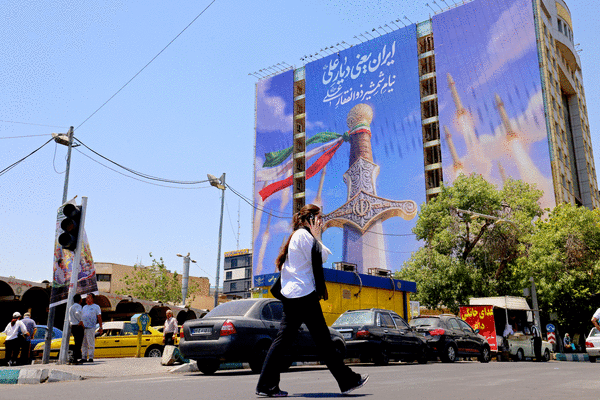
WASHINGTON — The U.S. military said it had launched strikes against “multiple” targets in Iran for the second day in a row after President Donald Trump accused the country of dragging out talks on an interim peace deal.
U.S. Central Command said it began what it called the “additional self-defense strikes” at 5:15 p.m. New York time on Wednesday.
The attacks, which followed strikes on Tuesday in retaliation for the downing of a U.S. Apache helicopter, underscored Trump’s growing impatience that the two sides have so far failed to reach an agreement. It also offered fresh evidence that a ceasefire agreed upon in April has all but collapsed, even though the U.S. and Israel haven’t returned to the intensive bombing campaign that marked the early days of the conflict.
Iran’s semi-official Tasnim news agency, citing a military source, said before the strikes began that the country’s armed forces were “fully prepared” for fresh attacks and had the ability to strike additional American targets.
Oil jumped on the strikes, with West Texas Intermediate crude surging as much as 2.6% to $92.39 a barrel after closing more than 2% higher in the previous session.
This week’s hostilities mark the most intense clashes between the U.S. and Iran in weeks. A further escalation risks derailing intermittent, indirect talks between Tehran and Washington.
Nikki Haley, Trump’s ambassador to the United Nations in his first term, told Bloomberg Wednesday she was skeptical a deal could be reached. “Iran was never going to do a deal,” she said.
For months, Trump has vacillated between threats of intensified attacks and boasting that a peace deal is within reach. Yet neither scenario has materialized and the Strait of Hormuz, a crucial waterway for oil and other commodities, remains largely closed despite American efforts to ease Iran’s chokehold.
“We’re going to be attacking them, attacking them very hard,” Trump told reporters at the White House Wednesday, before the latest strikes were announced. “We hit them hard yesterday, and we’re going to hit them hard again today.”
Centcom didn’t detail what targets the U.S. was striking, and Trump declined to say before the attack what targets U.S. forces would hit. Axios reporter Barak Ravid cited an unnamed U.S. official in a post on X who outlined military targets for Wednesday’s strikes, including air defense systems, radars and drone command and control units.
The Iranian Foreign Ministry accused the U.S. of hitting civilian infrastructure in strikes earlier this week.
Trump earlier Wednesday posted that the U.S. military had supported the passage of “more than 200 commercial ships” through the key waterway, resulting in “more than 100 million barrels of oil” making it to market. He went on to claim the U.S. controls the strait, “not Iran.”
Before Trump spoke, a White House official said talks were continuing but vowed that the U.S. would exert maximum pressure until a deal is reached. The semi-official Iranian Students’ News Agency reported that a Qatari delegation arrived in Tehran on Wednesday to discuss the diplomatic process to end the war.
“I think the war hasn’t really stopped,” said U.S. Senator Brian Schatz, a Democrat from Hawaii. “There’s no real evidence that a deal is in there.”
_____
With assistance from Meghashyam Mali and Nicholas Lua.
_____
©2026 Bloomberg L.P. Visit bloomberg.com. Distributed by Tribune Content Agency, LLC.





Comments