A year after the Hortmans were killed, legislators are still looking over their shoulders
Published in News & Features
MINNEAPOLIS — State Sen. Erin Maye Quade couldn’t sleep after last June 14. She started mistaking the sound of her dishwasher for an intruder or passing headlights for someone at her front door.
Her name was on Vance Boelter’s list, same as former House Speaker Melissa Hortman and Sen. John Hoffman.
The killer had a long list of Democrats he planned to target the night he murdered Hortman and seriously injured Hoffman.
“There’s no way to accurately describe the fundamental altering that this does to your life,” said Maye Quade, DFL-Apple Valley, “when you know that you were on a hit list and that an assassin had your name and address on a hit list.”
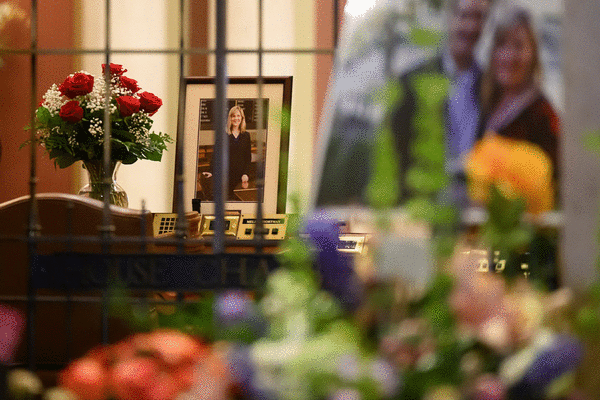
For Minnesota politicians, the June 14 attacks marked a painful shift to a new reality where political violence could reach their doors. At the State Capitol, visual reminders are unavoidable. Weapons screeners now stand at the entrance. Colleagues wear green memorial ribbons and maintain Hortman’s empty desk as a tribute. At home, elected officials have added home security systems and hired private security companies.
But the loss of Hortman and near-fatal shooting of Hoffman have also reverberated in deeply personal ways for many lawmakers. Some are more vigilant about their surroundings and more cautious about how they interact with the public or discuss their families. Some decided it was time to step away from public service altogether, even as others saw forging ahead as the best way to honor their late colleague’s legacy.
Rep. Emma Greenman is among the latter group. A year after the shooting, the Minneapolis DFLer says she has a greater sense of connection to her community.
“Grief … can lead to despair,” Greenman said. “It can also lead to purpose, and we’re seeing that.”
Since Hortman’s killing, a gunman killed conservative activist Charlie Kirk and another stormed the White House Correspondents’ Association dinner attended by President Donald Trump.
The spate of political violence has made tense exchanges with constituents especially concerning.
State Sen. Heather Gustafson said a man with a gun holstered on his hip approached her at a parade and told her “you don’t belong here.” A man who was angry with Democrats yelled in her face when she knocked on his door.
“It’s almost like we’re not human,” Gustafson, DFL-Vadnais Heights, said. “Everything that somebody might hate about a Democrat, they’re not going to be able to personally yell at Joe Biden, but I show up to their door and … now they can unload on me.”
Sen. Julia Coleman, a Republican, said after she voted against a DFL proposal to ban assault-style weapons in May, a constituent sent her an angry message that said: “I hope you personally experience gun violence.”
“There’s one thing with people sharing their opinion … it’s another thing when they’re name-calling constantly and saying the worst things you’ve ever heard,” Coleman said. “And I’ve certainly seen an uptick in that since June 14.”
Coleman said her decision to run for reelection was more difficult this year, particularly after the assassinations of Hortman and Kirk. Coleman previously worked with Kirk at his nonprofit, Turning Point USA.
“Seeing a friend I’ve known for over a decade take a bullet to the neck like that,” she said, “there was a brief moment after that (where) I went, ‘Are my kids going to have a mom if I keep doing this job?’”
Senate Minority Leader Mark Johnson, a Republican, recalled how his 11-year-old daughter called him the morning of June 14 to ask why a State Patrol vehicle was parked outside their home: “There was a lot of fear in her.”
One year later, Johnson said his teenage son still checks to make sure their doors are locked at night and sometimes will place a chair in front of the front door.
With political violence targeting Democrats and Republicans on the rise across the country, state capitols have imposed greater security measures.
More than two dozen states allow candidates to pay for personal security measures with campaign funds, according to the Vote Mama Foundation, which tracks the political participation of mothers. Most states adopted those policies after Hortman’s killing.
Minnesota lawmakers can now draw up to $4,500 from the House and Senate operating funds to pay for home security. The DFL Party offers funds to its candidates for security and spent $29,000 last year to protect DFLers at town halls and rallies.
The Legislature also passed bills this year to maintain weapons screening and enhanced security at the State Capitol, and to create a new unit within the Minnesota State Patrol to provide security to politicians who face credible threats.
Members of the public can no longer get as close to the front doors of the Minnesota House and Senate chambers. Security personnel monitor committee rooms and limit the number of people who can attend hearings on legislation.
While the threat to legislators’ safety — and that of their families — weighs on Johnson, he’s worried some of the security changes to the Capitol have driven a wedge between politicians and the public.
“A lot more locked doors to offices and office suites. There’s a lot more cordoning off,” Johnson said.
Senate Majority Leader Erin Murphy, DFL-St. Paul, said she wrestles with how lawmakers can continue their work in the face of violent threats. She said she didn’t realize how much responsibility she carries for the safety of people who choose to run for office until it was challenged.
“We’re living in a post-assassination Minnesota. It’s hard to quantify that ... but it’s, I think, altered me and it’s altered us.”
On Thursday, Vance Boelter pleaded guilty in federal court to killing Hortman and her husband, Mark, and shooting Hoffman and his wife, Yvette. Boelter also shot at the Hoffmans’ daughter, Hope, who was not injured. Boelter will serve life in prison.
Minnesota Attorney General Keith Ellison said he had received threats before the killings. But they seemed “remote and unlikely.” Now, he said, they feel wholly possible.
Ellison said he is “still shocked” by Hortman’s killing. But if the goal of the crime was to intimidate people, he doesn’t think it worked. Her killing, the mass shooting at Annunciation Catholic Church and School and the federal immigration crackdown, he said, mobilized Minnesota.
“We have this reputation of being nice,” Ellison said of Minnesotans, “but we know and the country now knows that we might be nice, but we’re actually pretty tough and can take a punch and get back up. I think there is a new spirit of activism, and I think Melissa is certainly part of that.”
Gov. Tim Walz said he hasn’t let threats change his approach to governing and campaigning.
“I think that’s the thing that political violence wants to do,” he said. “It wants to chill that.”
Walz said in an interview that the family still receives threats “constantly.” Some are serious, he said, but most aren’t.
Minnesota House Speaker Lisa Demuth, a Republican, said she’s faced more threats since June 14 than she had in her previous years in office. The elevated danger is on her mind when she attends public events.
The risk of public life has also been felt more broadly across the House GOP Caucus, Demuth said. Some lawmakers decided to retire from public service during this fraught moment. Still, Demuth said, there were others who said they were “not going to let fear hold us back.”
Demuth, who is running for governor, is among those who are undeterred.
“It’s still really important work,” she said. “Minnesota’s too good to give up on. I’m not gonna quit.”
©2026 The Minnesota Star Tribune. Visit startribune.com. Distributed by Tribune Content Agency, LLC





Comments