Report warns world is falling behind in race to remove carbon from the air
Published in News & Features
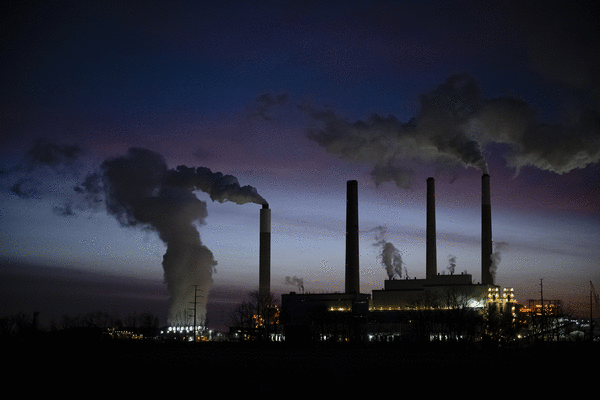
Taking carbon out of the atmosphere was never going to be easier than keeping it out of the skies, but the cleanup strategy is already hitting a wall, according to a new report on the state of carbon dioxide removal published in early June.
Removing carbon dioxide, in addition to rapid and deep emission cuts, will now both be necessary to limit human-generated climate change to 1.5 degrees Celsius, wrote University of Maryland professor Matthew Gidden and a team of international researchers in “The State of Carbon Dioxide Removal 2026.”
Removal, such as from air-scrubbing technology, must result in deep, secure storage of carbon rather than technologies that would reburn it for fuel, they wrote.
Carbon dioxide emissions “have an enduring effect on the climate, causing global temperature to rise and stay elevated for millennia,” they wrote. Currently, removal efforts around the globe are barely having an impact and would need to be scaled up at rates that rival solar power investment.
“Countries have pledged around 2.7 billion (metric tons) of carbon removal by 2035 and about 3.6 billion by 2050, but climate pathways require much more, especially in the long term,” report co-author William Lamb, a scientist at the Potsdam Institute for Climate Impact Research, told The Guardian. “This leaves a gap that grows significantly over time.”
Removal could look like new machines that suck carbon from the air and chemical techniques, such as producing biochar — a charcoal-like substance made by burning organic waste — for fertilizer. However, most of the carbon removal still comes from planting trees, according to the researchers.
The independent scientific assessment, now in its third publication, found signs that support for carbon removal has weakened globally. The report notes that the United States, under President Donald Trump, withdrew from the Paris climate agreement while promoting fossil fuels.
In addition, the report said Microsoft, which has purchased 82% of carbon credits, has paused purchases. While first movers like Microsoft were important in establishing carbon credit markets, the authors wrote that “vulnerability emerges” if their actions are not adopted more broadly.
That’s despite new forms of carbon removal growing at a rate of 40% a year, they found.
“It remains the only option to revert climate change in the long run — although only if greenhouse gas emissions are also reduced to near-zero,” Thomas Gasser, a scientist at the International Institute for Applied Systems Analysis, told Futurism.
_____
©2026 Baltimore Sun. Visit baltimoresun.com. Distributed by Tribune Content Agency, LLC.






Comments