'We're benefiting': Trump showcases Maduro raid on the world stage
Published in News & Features
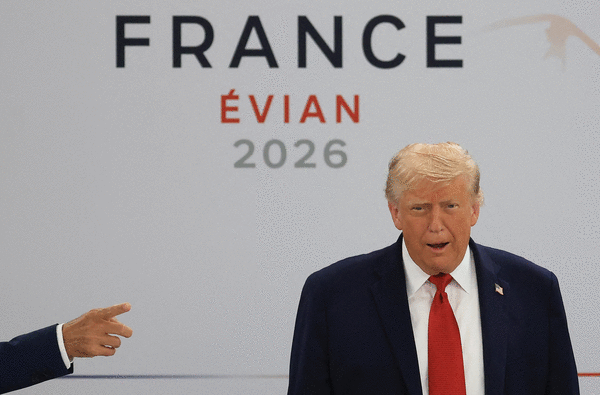
Nearly six months after the capture of Nicolás Maduro, President Donald Trump is increasingly portraying the operation as one of the defining victories of his foreign policy, arguing it transformed Venezuela from a hostile adversary into a strategic partner.
Speaking to reporters during the G7 summit in France, Trump pointed to the U.S.-backed operation that removed the Venezuelan strongman as evidence of what he described as the effectiveness of his administration’s strategy of combining military force with economic leverage.
Trump described the Jan. 3 mission as a rapid, decisive operation that fundamentally reshaped Washington’s relationship with Caracas.
“We have the world’s most powerful army,” Trump said. “You saw it with Venezuela, in an operation which was 48 minutes, and now our relationship with Venezuela is great.”
The operation ended years of open hostility between Washington and Caracas and opened the door to unprecedented cooperation with Venezuela’s interim government under President Delcy Rodríguez, who assumed power after Maduro’s removal.
Since then, the United States and Venezuela have expanded cooperation in areas that include energy policy, migration, counter-narcotics and regional security. The partnership has already produced joint security operations, including actions targeting transnational criminal groups such as Tren de Aragua.
Trump also framed the Venezuela intervention as a major economic success, saying the United States recouped the cost of the operation many times over through gains tied to global energy markets.
“We paid for the cost of the war 40 times, taking millions of barrels out,” Trump said. “Venezuela’s benefiting, we’re benefiting.”
Trump did not elaborate on what he meant by “taking millions of barrels out,” but the remarks appeared to reference shifts in global oil flow following the normalization of ties between Washington and Caracas. Since Maduro’s removal, Venezuela has gradually expanded cooperation with U.S. energy companies under a regulatory framework backed by the Trump administration.
The Jan. 3 raid that toppled Maduro was a lightning-fast U.S.-backed operation lasting less than an hour and ending with the capture of the longtime Venezuelan ruler in Caracas. U.S. officials said the mission targeted Maduro after Washington accused his government of deepening ties with narcotrafficking networks and transnational criminal groups, including Tren de Aragua and the Cartel de los Soles.
Maduro was swiftly removed from power and transferred into U.S. custody to face drug trafficking charges in New York, bringing an abrupt end to more than a decade of authoritarian rule that had made him one of Washington’s most entrenched adversaries in the Western Hemisphere.
Within hours of Maduro’s removal, then-Vice President Delcy Rodríguez was sworn in as interim president, pledging to preserve state stability and prevent institutional collapse. Since taking office, Rodríguez has emerged as Washington’s principal interlocutor in Caracas, working closely with the Trump administration under what officials describe as a three-stage stabilization plan aimed at restoring security, reviving the economy and laying the groundwork for political normalization in Venezuela.
_____
©2026 Miami Herald. Visit miamiherald.com. Distributed by Tribune Content Agency, LLC.



Comments