Commentary: 'Super meth' isn't exactly real, but the drug is a real factor in LA homelessness
Published in Op Eds
In last week’s mayoral debate, candidate Spencer Pratt said “super meth” was driving homelessness in Los Angeles.
After several years reporting and writing a book on this topic, I can say that Los Angeles, indeed the United States, doesn’t necessarily have a “super meth” problem.
Meth is meth. Like aspirin is aspirin. What matters is how much is in each dose.
Today, Los Angeles does have a hyper-pure methamphetamine problem. It is a major driver of homelessness and mental illness here and in many other parts of the country.
But it’s not new.
Twenty years ago, what was sold on the street as meth was 40% to 50% meth, the rest being cheap filler that dealers used to expand their supply.
Today, meth made in Mexico and sold on U.S. streets routinely measures more than 90% pure — and has for more than a decade. The catastrophic results have been visible on L.A. streets for some time now.
Here’s what happened: For many years, the Mexican trafficking world used a decongestant called ephedrine as the principal ingredient in its methamphetamine. Ephedrine is difficult to make. Traffickers never could get enough ephedrine to make meth in quantities sufficient to cover more than parts of the western United States. In other parts of the country, local meth cooks used Sudafed pills to extract ephedrine to make small quantities of low-quality, high-priced meth.
In 2008, the Mexican government reduced the allowed amounts of imported ephedrine, which traffickers had always siphoned for their illicit uses.
They switched to another method — old but new to them, with a central ingredient called phenyl 2 propanone, an industrial chemical called P2P for short.
The P2P method has one huge advantage over the ephedrine method: ease of access to the key ingredient.
P2P can be made many ways, using a variety of legal, cheap, widely available industrial chemicals. Unlike the ephedrine method, traffickers could make meth using P2P in quantities. They were constrained only by access to these ingredients, which, considering they control Mexico’s main shipping ports, is almost limitless.
By 2013, staggering quantities of cheap, very pure, and highly addictive Mexican meth were flowing into the United States. By 2014, from my reporting, meth had dislodged crack as the main drug for sale on Skid Row in Los Angeles.
By 2016, hyper-pure meth was covering the Midwest. In 2020, meth was reaching into New England, which had never seen much before.
Remarkably, hyper-pure meth covered the country and its price dropped by 80%. Local meth cooks couldn’t compete and vanished.
Street dealers seem reluctant to dilute their supplies, perhaps fearing customers would go to their competition. Whatever the case, samples of seized methamphetamine across the United States routinely test above 90% pure, according to the Drug Enforcement Administration.
The old ephedrine-based meth, consuming and addictive, was widely used as a social drug. Users wanted to be around others. It was big in the gay community, often referred to as T or tina. Its harmful effects became clear over time. Remember the famous “Faces of Meth” posters with users’ mugshots over a half-dozen years, showing dramatic physical decline?
The effects of this hyper-pure meth, however, were quite different. Users were plunged into their own sleepless, tormented isolation and symptoms of profound mental illness. They grew paranoid, belligerent, violent, deranged — and in many cases, quickly devolved into homelessness.
Meth-induced psychosis became indistinguishable from schizophrenia, except that the latter affects mostly young men 16 to 30.
Given the drug’s relentless prevalence, purity and affordability, people homeless for any number of reasons used it to stay awake all night, for days, to defend against rape, robbery, beatings — exacerbating their addiction and chaining them further to the streets.
By 2018, fentanyl arrived, wreaking its own lethal havoc and grabbing most of the headlines. Meth was, by comparison, rarely mentioned in media reports. Yet where homelessness is concerned, meth is the more pervasive illegal drug on L.A. streets. It also is more likely to create the disturbing, erratic, sometimes violent, public behavior that Angelenos have come to associate with homelessness.
In Los Angeles, meth was accompanied by factors that enhanced its damage.
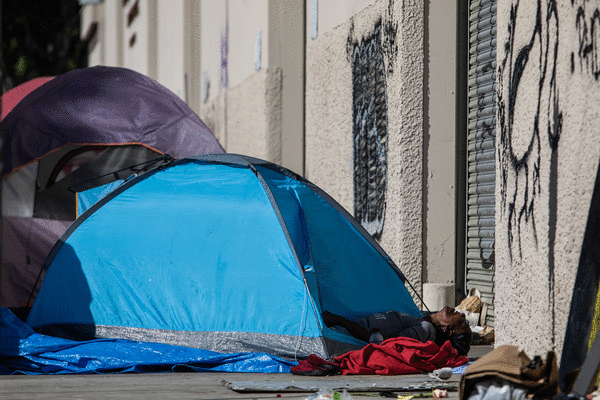
First was the spread of tents. In 2011, the Occupy movement normalized tents on public sidewalks. Tents then colonized Skid Row, transforming the nature of the city’s homeless, who were now stationary and thus easy targets for drug dealers, pimps and others.
Addicts in tents, immersed in endless supplies of meth and now fentanyl, were rarely ready for treatment, which they routinely refused.
In encampments, this hyper-pure methamphetamine famously prompted hoarding of items others viewed as junk. Bicycle parts were of particular interest, hence the tented “bike shops,” with piles of disassembled parts, so common in L.A. encampments during the COVID-19 pandemic.
All this was further encouraged by a series of court cases that the city interpreted to mean it could do nothing about those encampments.
A tent-based, “skidrowified” homelessness, often enhanced and emboldened by meth addiction, spread. It went first to Venice, then Hollywood, Koreatown, Mid-City South L.A. and freeway exits and overpasses as the hyper-pure form of the drug settled over the city. A vast encampment on the Venice boardwalk became known as “Methlehem.”
Tents became vectors of disease but also of meth use, where the drug was all but free — or was bought with sex.
This is what the city faces today: a tent-based homelessness problem that is hard to untangle from the relentless supplies of hyper-pure meth coming from Mexico.
The next mayor will have to find solutions using dramatically different thinking than what’s been employed up to now.
____
Independent journalist Sam Quinones, a former Times reporter, is the author of, among other books, “The Least of Us: True Tales of America and Hope in the Time of Fentanyl and Meth.” He writes the Dreamland newsletter on Substack.
©2026 Los Angeles Times. Visit at latimes.com. Distributed by Tribune Content Agency, LLC.






































Comments