Tillis warns of midterm impact of 'unforced errors,' shifting some blame to Trump
Published in Political News
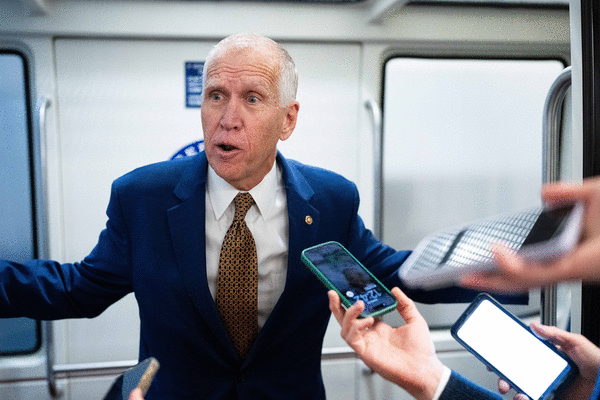
WASHINGTON — Sen. Thom Tillis wants the White House to stop making “unforced errors” that could affect the midterms.
And in a rare move, Tillis shifted his blame for the administration’s actions from President Donald Trump’s advisers to both the president and his advisers.
Senate Majority Leader John Thune sent lawmakers home early June 24 for a two-week Fourth of July recess after Trump refused to sign into law what his own White House called a “historic” housing bill that had taken months to negotiate.
Republicans planned to campaign off the bill to demonstrate the party’s commitment to affordability, a point of contention cited in recent months by polled voters.
Currently, Republicans control the White House and both chambers of Congress. But the margins between the two parties are slim, and the party controlling the White House historically performs worse in midterm elections. Favorability of both the president and Congress is waning, leading political experts to believe a blue wave is plausible.
Republicans are looking for wins they can use in their campaigns.
So after the passage of the Housing of the 21st Century Act, by Congress, Statuary Hall at the U.S. Capitol was turned into a set with all the pomp and circumstance one would expect from an American bill signing that was meant to capture attention.
Until Trump announced it was canceled.
Trump was moments away from taking the stage when he posted on social media he wouldn’t sign the bill until the Senate passed the SAVE America Act, a voter ID bill that doesn’t have enough Republican support to be enacted.
Trump’s decision sent Congress into a tailspin. Rep. Anna Paulina Luna, a Republican from Florida, siding with Trump, jammed the House floor, using Republican hardliners’ votes to prevent other legislation from moving forward without the election bill.
Thune sent Senate Republicans home.
Blaming Trump
Tillis, a Republican from Huntersville, said it marked the third time in five weeks a decision from the White House derailed a major piece of legislation. And while Tillis has always been careful to avoid blaming Trump and instead focus on Trump’s political advisers, he wasn’t so cautious when talking to McClatchy in an exclusive interview two days after senators left town.
“I look at it this way,” Tillis said, “if the president is making snap decisions — because I’ve said before there are two ways ... the president gets ... bad advice: one is giving it to him. The other one is failing to give him an idea of the second or third order of consequences to some of the things he wants to do. I’d like to think that he got that; if he didn’t, then clearly it’s on him. On the one hand, if he didn’t, it is also on whoever is around him who should be protecting him.”
Some politicos have gone even further than Tillis and questioned whether the president was actively sabotaging the Republican Party, The New York Times reported.
Video from inside Statuary Hall showed Rep. Virginia Foxx, a Republican from Banner Elk, already making her way to her seat to witness Trump’s bill signing when reporters told her it was canceled.
It’s rare for the president to come to the Capitol to sign a bill. The White House spent the prior evening touting the importance of it. It was intended to make building housing cheaper and easier. White House Press Secretary Karoline Leavitt called it “one of the most significant pieces of housing affordability legislation in history.”
“President Trump promised to lower housing costs, and he is delivering, making it easier for every family to achieve the American Dream of homeownership. Tomorrow’s historic bill signing is another promise made, promise kept.”
On Monday, Trump called it “a yawn.”
Five weeks of chaos
Tillis said this is just the latest piece of a negative streak for Republicans that began five weeks earlier and needs to be broken.
He said it started when the Department of Justice announced the “1776 fund” that set aside $1.776 billion for people who believe they were targeted by the government. It was part of a settlement between Trump and the IRS after Trump sued over the leak of his tax return. In exchange, the IRS agreed to never investigate Trump, his family or his businesses.
The Senate’s backlash to Trump’s fund came quickly and temporarily delayed passage of a bill providing immigration enforcement funding.
From there, the Senate began debating a renewal of Section 702, of the Foreign Intelligence Surveillance Act, which allows the government to spy on non-U.S. citizens without warrants.
Section 702’s authorization expired at midnight June 13.
And both parties planned to extend the measure, until Trump appointed political ally Bill Pulte to serve as acting director of national intelligence, despite a lack of relevant experience for the job.
“... You’re in the middle of Section 702,” Tillis said, “and you put one of the most polarizing figures in the administration over national intelligence, and so that undermines what we were trying to do for a reauthorization with some reforms that sidelined 702.”
Section 702 has not been renewed.
And that brought the Senate to last week.
“We continue to say, ‘Let’s focus on making the tax provisions permanent, the impact it’s having on the economy, we’ve got our focus — the things that we ought to focus on for affordability: pass a housing bill, schedule a signing ceremony, which is a rare thing to do in the Capitol, unless you want to draw a lot of attention to it, glowing remarks the night before from the White House Communications Office and spokespeople, and cancellation,” Tillis said. “Now intrigue over a veto. So these are all just a lack of coordination.”
Trump has 10 days to sign a bill once it reaches his desk, or it becomes law automatically. His other option is to veto the bill and send it back to Congress.
Speaker Mike Johnson told reporters Monday that Trump won’t veto the bill.
The SAVE America Act
The SAVE America Act passed the House by a vote of 220-208 on April 10. All of North Carolina Republicans voted in favor of it, while every Democrat voted against it.
In February, after a similar version of the bill passed the House, Sen. Ted Budd called on the Senate “to act” on the bill.
“Simple, commonsense reforms to protect election integrity, like proof of citizenship to register & presenting ID to vote, are supported by 80% of Americans,” Budd, a Davie County Republican, posted on social media. “We must ensure only U.S. citizens vote in U.S. elections.”
But Tillis argues that there isn’t enough time to implement the SAVE America Act before the midterms.
“Unless they do the work to get to the 60 votes, they know it’s dead, and so all this is theater,” Tillis said. “And honestly, here in North Carolina, or in virtually any state, the ability, if we go back to when we implemented voter ID in North Carolina, it took a year to get everything in place with adequate funding.”
Tillis said it’s impossible to implement this bill without ending all early voting for November’s election.
“Let’s assume you only allow early voting in the month of October,” Tillis said. “Then do you honestly believe that we can have this thing up in 50 states? There’s no funding. There’s no specific implementation instructions … it’s become a joke, in my mind for somebody that’s actually implemented voter ID law, how anybody can look the American voters in the eye and suggest that it could be implemented in time without just causing a huge impact on the elections, and ironically undermine the confidence of it.”
Ending the filibuster
Tillis said that it’s “almost embarrassingly transparent” that maneuver has more to do with eliminating the filibuster, something he’s been vocally opposed to for years.
Despite having a majority, Republicans do not have 60 votes to end debate on the SAVE America Act and allow it to come up for a floor vote.
There have been calls to force Democrats into a talking filibuster, making them debate until they’re exhausted and agree to voting with a simple majority.
Tillis has been a vocal opponent of nuking the filibuster and took to social media to chastise Sen. Mike Lee, a Republican from Utah, for suggesting it, calling his idea “goofy stuff.”
On Monday, Trump told reporters it would be best to eliminate the filibuster and blamed Tillis and four others for standing in his way. He also wrongly asserted that Tillis is no longer in office.
Tillis remains in office through the end of his term that expires in January. Tillis said Friday that he and Trump maintain a friendly relationship and were texting that morning, but wouldn’t get into details about the topic.
Tillis said he doesn’t waste his time talking to Trump about things he knows the president is dug in on.
Campaign distraction
Tillis said the last five weeks have distracted from the conversations needed around Republican campaigns.
“We’ve got to stop this stuff, these unforced errors,” Tillis said.
Tillis said last week that Republicans should have been busy campaigning off “all the Democrat socialists that got elected and the rise of (New York City Mayor Zohran) Mamdani as the face of the Democratic Party.”
Mamdani endorsed three far-left candidates in last Tuesday’s New York primary and all three won.
“All the oxygen got sucked out of the room because it was Republican versus Republican up here versus just this incredible strategic opportunity,” Tillis said. “We’ve got to be disciplined, stop the petty, personal sort of priorities.”
He said the priority needs to be the interests of the GOP candidates who are currently running.
Tillis said his entire focus now through November is helping those lawmakers. He doesn’t want any more surprises or chaos.
“American voters do not like chaos,” Tillis said.
Tillis says Republicans can refocus
But Tillis doesn’t believe it’s too late for Republicans.
He said he uses June 30 as a barometer. Tillis ended his reelection campaign June 29, 2025, after publicly sparring with Trump over the impact a bill Trump championed would have on Medicaid recipients in North Carolina. Tillis said he decided he couldn’t effectively run the campaign he needed to win.
For Tillis, June 30 is when the average voters’ focuses go toward their summer plans, Congress prepares to leave for the August recess and attention starts to gravitate toward candidates without distractions from Capitol Hill.
“That’s the time to have our candidates get out, send a positive message, and be consistent with whatever’s coming out of the White House, the Congress, and for that matter, the state legislatures,” Tillis said. “I mean, we all need to be rowing in the same direction, because the national move can help the local move.”
Tillis said Republicans need to know how to get their messaging out and point to the good things the Trump administration is doing.
“I support the majority of it,” Tillis said. “It’s all this other stuff. It’s just unfortunate.”
©2026 The News & Observer. Visit at newsobserver.com. Distributed at Tribune Content Agency, LLC.
















































Comments