Why Some Cats ‘Talk’ More Than Others
Published in Cats & Dogs News
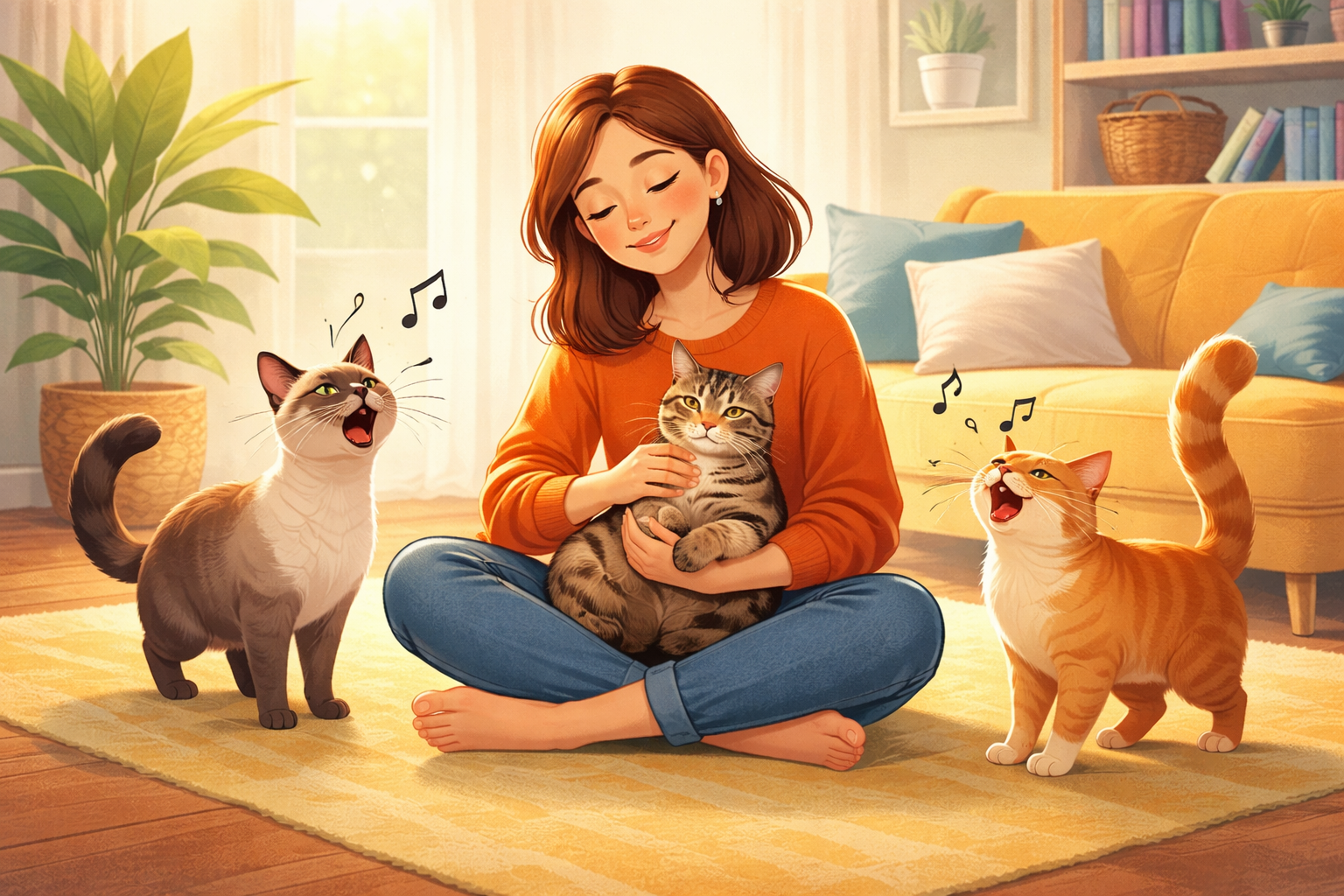
On any given evening in a quiet home, one cat may sit silently in a corner, blinking slowly and observing the world like a furry philosopher. Another may follow its owner from room to room, narrating every movement with chirps, trills, meows, and insistent commentary. To many pet owners, this difference feels mysterious. Why does one cat seem almost conversational, while another treats silence as a virtue?
The answer lies in a complex mix of genetics, early social experiences, environment, and the unique social bond each cat forms with humans. Far from being random, feline “talkativeness” reflects how cats have adapted their ancient communication systems to life with people.
Meowing Is a Learned Human Language
Unlike dogs, whose vocalizations are used frequently with other dogs, adult cats rarely meow at each other. In the wild or among feral colonies, cats rely more on body language, scent, and subtle vocal cues. Meowing is primarily a behavior cats use with humans.
Kittens learn early that vocal sounds attract attention. A hungry kitten who cries gets fed. A lonely kitten who squeaks gets comfort. Over time, many cats refine this behavior into a flexible communication tool, adjusting pitch, volume, and timing depending on what works. Some cats develop an impressive “vocabulary,” using different sounds for food, play, protest, greeting, or complaint.
In this sense, talkative cats are not simply noisy. They are fluent in what researchers sometimes call “human-directed vocalization,” a learned system tailored specifically for interacting with people.
Genetics and Breed Tendencies
Some cats arrive in the world already inclined toward vocal behavior. Genetics plays a measurable role in how expressive a cat becomes, just as it does in temperament, curiosity, and sociability.
Certain breeds are famously chatty. Siamese, Oriental Shorthairs, and related breeds are known for loud, persistent, and emotionally expressive voices. Maine Coons often chirp and trill. Bengals tend to produce complex, unusual sounds. These traits did not appear by accident. Over generations, breeders selected cats that were socially engaged and responsive, unintentionally reinforcing vocal tendencies.
Even among mixed-breed cats, inherited personality traits influence how likely a cat is to “speak up.” Some are naturally bold communicators. Others are genetically predisposed to caution and reserve.
The Role of Early Socialization
The first few months of a kitten’s life are crucial for shaping communication habits. Kittens raised closely with attentive humans often learn that vocalization is effective. Those who are spoken to, answered, and rewarded with attention for making noise tend to keep doing it.
Conversely, kittens raised in quieter environments, or with limited human interaction, may never develop strong vocal habits. Feral-born kittens who are later socialized often remain relatively quiet, relying more on posture and movement than sound.
Early experiences also influence confidence. A kitten who learns that its voice matters grows into a cat that expects to be heard. One whose signals were often ignored may become more withdrawn.
Personality and Emotional Needs
Talkativeness is also closely tied to personality. Highly social cats often use vocalization as a form of relationship maintenance. They meow to check in, to request interaction, and to keep track of their human companions.
Some cats are emotionally expressive. They vocalize frustration, excitement, boredom, anticipation, and affection. Others process emotions internally, showing little outward response.
Anxiety can also increase vocal behavior. Cats who feel insecure may cry more, especially when separated from owners or confronted with changes in routine. In these cases, “talking” functions as reassurance-seeking.
Human Reinforcement Shapes the Conversation
Perhaps the most powerful factor in feline chatter is human behavior. Cats are expert observers. They quickly learn which actions produce results.
If a cat meows and receives food, attention, or conversation in return, the behavior is reinforced. If a cat is consistently ignored, it may stop trying. Over months and years, owners and cats effectively train each other into communication patterns.
Many people unknowingly participate in daily “conversations” with their pets. They respond verbally, laugh, answer questions, and negotiate boundaries. For a responsive cat, this becomes a rewarding social exchange.
In homes where owners talk frequently to their cats, the cats often talk back.
Aging, Health, and Changing Voices
Vocal behavior can change over time. Senior cats sometimes become more talkative due to cognitive changes, reduced vision or hearing, or increased need for reassurance. Nighttime yowling, in particular, may reflect confusion or disorientation.
Medical issues can also affect vocalization. Pain, hyperthyroidism, and sensory loss sometimes lead to increased crying. When a normally quiet cat becomes suddenly vocal, a veterinary evaluation is wise.
At the same time, many older cats simply become more communicative as their bond with owners deepens. Years of shared routines create a rich system of signals and responses.
Not Silence, Not Noise—Just Different Languages
Quiet cats are not less loving. Talkative cats are not necessarily more demanding. Each represents a different communication strategy shaped by biology and experience.
Some cats prefer subtlety: slow blinks, tail movements, gentle headbutts. Others prefer sound. Both are valid expressions of feline social intelligence.
Understanding these differences allows owners to respond more thoughtfully, strengthening trust and reducing frustration on both sides of the relationship.
In the end, a “talkative” cat is not simply making noise. It is participating in a shared language—one developed through evolution, learning, and daily life with humans.
========
Maribel Hartwick is a freelance pet and science writer who explores animal behavior, cognition, and the evolving relationships between humans and their companion animals. This article was written, in part, utilizing AI tools.







Comments